BEST PRACTICES IN
INFECTION CONTROL
Evidence-Based Prevention: Better than a pound of cure
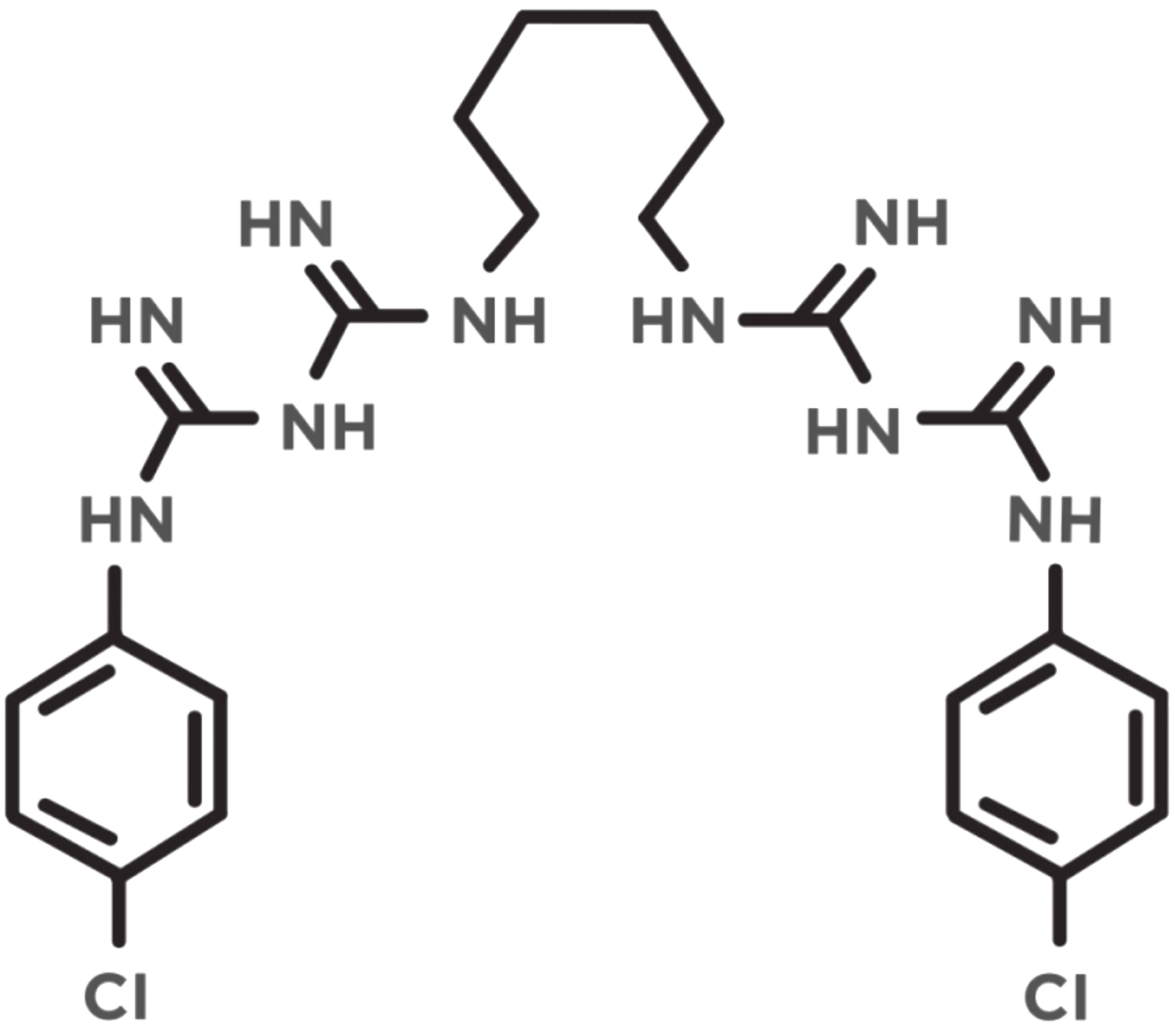
The Molecule
Chlorhexidine
(1:6di{4chlorophenyldiguanido}hexane)
Chlorhexidine is characterized as being a strong base with cationic properties.
In healthcare or commercial use, CHG is one of the more commonly used forms of the chlorhexidine salts due to its ability to dissolve in water and deliver the molecule in an effective way.
Scenario
Hospitals and communal areas are ideal environments to spread pathogens, including antimicrobial-resistant organisms like Methicillin-Resistant Staphylococcus aureus (MRSA) and Vancomycin-Resistant Enterococci (VRE).
Implementing institutional strategies and utilizing tools designed to reduce infections is essential to ensure patient safety, reduce financial risk, and achieve targeted infection rates.
Chlorhexidine, in many applications, has become the gold standard for infection reduction and prevention.

Effective and Safe
Chlorhexidine is an ideal broad-spectrum antimicrobial.
It is effective against Gram-positive bacteria, Gram-negative bacteria, and fungi. These organisms are commonly associated with Healthcare-Associated Infections (HAIs).
With its low toxicity level, chlorhexidine offers a safe side effect profile.

Credible History
For nearly 60 years, chlorhexidine has been used by hospitals and clinics.
Used as disinfectant and antiseptic for topical and hard-surface applications.
Chlorhexidine has become an integral part of the strategy to prevent the transmission of disease and nosocomial infections.

RECOMMENDED BY CDC CENTER FOR DISEASE CONTROL
Guidelines for prevention of Intravascular Catheter-Related Infection (2011)
Skin Antisepsis
A > 0.5% Chlorhexidine skin preparation with alcohol.
Antimicrobial Catheter
Use of an antimicrobial catheter (Chlorhexidine/Silver Sulfadiazine CVC option).
Patient Cleansing
Use a 2% Chlorhexidine wash for your daily skin cleansing.
Needleless Connectors
Scrub the access port with an appropriate antiseptic Chlorhexidine option.
Guidelines for Hand Hygiene in Health-Care Settings (2012)
Hand Hygiene
Decontaminate hands with non-antimicrobial soaps (Chlorhexidine soap option). Wash hands before eating and after using the restroom with non-antimicrobial or antimicrobial soap (Chlorhexidine soap option).
Preoperative Surgical Scrub
Surgical hand antisepsis using either an antimicrobial soap (Chlorhexidine soap option) or other means of hand hygiene before donning sterile gloves

Guidelines for Prevention of Surgical Site Infection (1999)
Presurgery Shower or Bath
Decontaminate hands with non-antimicrobial soaps (Chlorhexidine soap option).
Preoperative Skin Preparation
Antiseptic Agent (Chlorhexidine).

TARGETED VERSUS UNIVERSAL DECOLONIZATION TO PREVENT ICU INFECTIONS
Decolonization: Reduced transmission and prevents disease in MSSA and MRSA.
Daily Chlorhexidine bathing of ICU patients: Decreased rate of bloodstream infection.
Susan S Huang, M.D., M.P.H., Edward Septimus, M.D., Ken Kleinman, ScD, Julia Moody, M.S., Jason Hickok, M.B.A., R.N., Taliser R. Avery, M.S., Julie Lankiewicz, M.P.H., Adriana Gombosev, B.S., Leah Terpstra, B.A., Fallon Hartford, M.S., Mary K. Hayden, M.D., John A. Jernigan, M.D., Robert A. Weinstein, M.D., Victoria J. Fraser, M.D., Katherine Haffenreffer, B.S., Eric Cui, B.S., Rebecca E. Kaganov, B.A., Karen Lolans, B.S., Jonathan B. Perlin, M.D., Ph.D., and Richard Platt, M.D., for the CDC Prevention Epicenters Program and the AHRQ DECIDE Network and Healthcare-Associated Infections Program.